
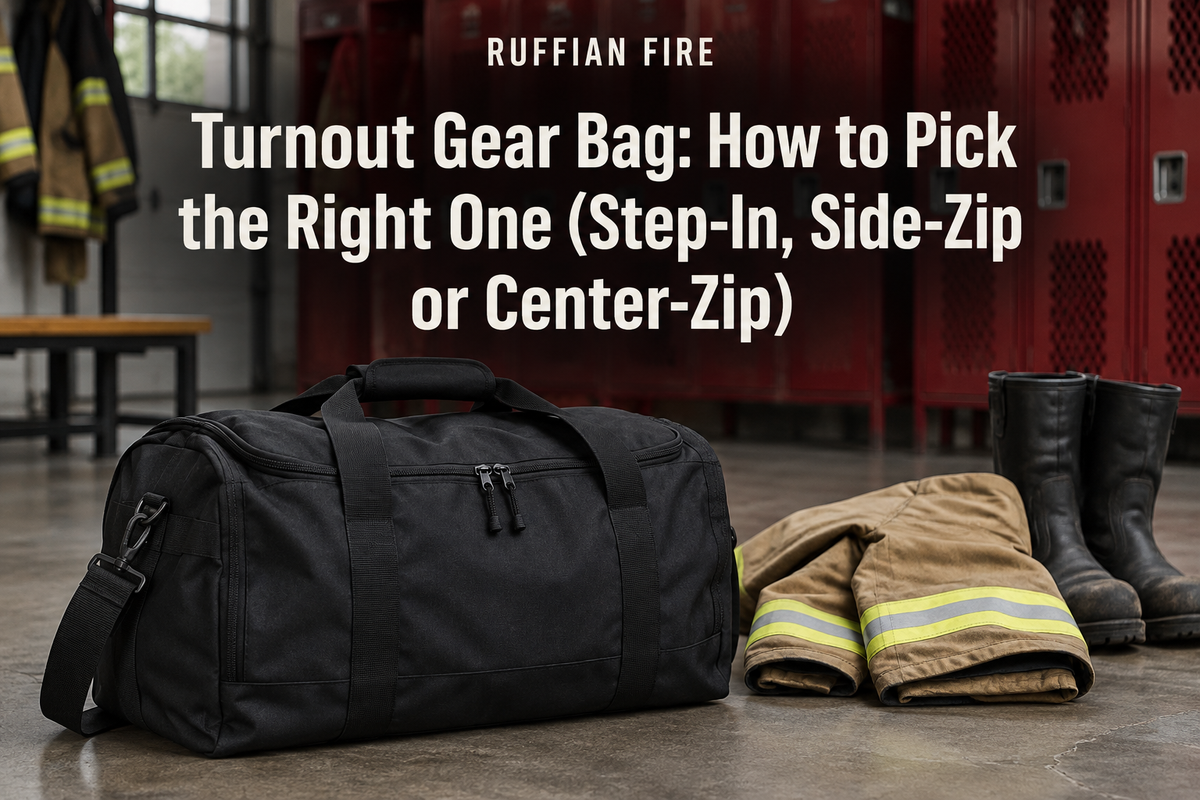
Every firefighter who has owned more than one gear bag has a strong opinion about which style they will never buy again. Ask around the station and you will hear it: "the zipper's in the wrong place," "I can never find my hood," "it doesn't stand up on its own." Almost all of that comes down to one choice made before the bag was ever bought: step-in, side-zip or center-zip.
We have built turnout gear bags in Hemet, California since 1986, in all three styles, and we get asked which one to pick more than almost any other question. Here is the honest answer, style by style.
The three styles, side by side

Step-In Turnout Gear Bag · $215
Main compartment 20"H x 18"L x 16"W, two side pockets 18"H x 14"W x 4"D. Heavy #8 duck canvas, 3oz suede bottom, YKK #10 zippers, suede-wrapped handles.
Turnout Gear Bag, Side Zipper · $200
32"L x 16"W x 12"H. Heavy #8 cotton duck, suede leather bottom, detachable adjustable shoulder strap, ID window, red or black.
Turnout Gear Bag, Center Zipper · $200
32"L x 16"W x 12"H. Same heavy #8 cotton duck and suede bottom, zipper runs along the top center instead of the side.
Which Style Fits How You Respond
Before the zipper placement, ask where the bag actually lives and how you get into it.
At the station, on a shelf or in a locker? A side-zip or center-zip bag is built for this. It sits flat, stays closed on its own, and you unzip the top or side to pull gear out without lifting the whole bag down.
In the back of your own vehicle, loaded and unloaded daily? The step-in style earns its keep here. You do not dig through it, you step into your turnouts standing inside the open bag, pull up, step out and zip. For a quick-turn response from home or a part-time or volunteer schedule, that is a real time difference.
Shared storage, multiple bags that look alike? The side-zip bag's ID window matters more than people expect. At a glance, in a dim apparatus bay, you want your bag and not the next size up.
None of the three is objectively "better." They solve different problems, and the wrong one is usually just a style mismatched to where and how you actually gear up.
Step-In Bags
The step-in design keeps your turnouts standing open inside the main compartment, boots already in place at the bottom if you pack it that way. Unzip, step in, pull your coat and pants up and on, step out of the bag, zip, go. It is built for speed at the moment that matters.
The tradeoff is footprint. At 20"H x 18"L x 16"W the main compartment has to be tall enough to stand turnouts in, so it takes more vertical space in a locker than a flat side-zip bag does. The two side pockets, 18"H x 14"W x 4"D, handle gloves, goggles and a spare pair of socks without you needing to open the main compartment at all.
Construction is heavy duck canvas with a 3oz suede bottom and YKK #10 zippers. We tell people straight: this bag costs more than the others, and it earns that cost back over a career of mornings where ten seconds matters.
Side-Zip and Center-Zip Bags
These two share a build: 32"L x 16"W x 12"H, heavy #8 cotton duck, a suede leather bottom, and a detachable adjustable shoulder strap. The difference is only where the zipper runs.
Side-zip puts the opening along the long side. Set the bag on a shelf and unzip it like a suitcase lying flat, gear fully visible at once. It also carries an ID window, useful for departments issuing matching bags to a full crew.
Center-zip runs the opening along the top center, more like a traditional duffel. Easier to load fully packed gear in one motion, and the one most people reach for if they are used to a standard duffel bag.
Either one rides well in a trunk or an apparatus compartment and holds a complete set of turnouts without the bag standing as tall as the step-in style needs to.
Sizing for a Full Set of Turnouts
A full set, coat, pants, boots, helmet and hood, needs real volume, and the three bags size it differently.
The step-in's 20"H x 18"L x 16"W main compartment is built around the height of a hung coat and pants rather than raw liters, so turnouts go in already shaped the way you will put them on. The side-zip and center-zip bags, at 32" long, are built around laying gear flat, which fits a coat, pants and boots side by side rather than stacked.
If you are outfitting more than one person, for an academy class or a smaller department, the Academy Turnout Bag at $75 is a lighter-duty option sized for recruits before they are issued a full-career bag. It is not built to the same spec as the three above, and we would not sell it to a twenty-year veteran, but it is the right fit for a class that needs ten bags at once without ten bags' worth of budget.
Whatever bag you land on, a Turnout Tool Roll, 7 Pocket at $35 or the 5 Pocket version at $25 keeps webbing, a flashlight and small tools organized inside the main compartment instead of loose in the bottom.
What Makes a Turnout Bag Last a Career
We say it on every one of these product pages because it is true and because people ask: a turnout bag costs more than a department-store duffel, and it should last your entire career if it is built right. Here is what to check, on ours or anyone else's.
- The fabric. Heavy #8 cotton duck or duck canvas holds up to being dragged across apparatus floors and tailboards in a way lighter synthetic fabrics do not.
- The bottom. A 3oz suede leather bottom takes the abrasion that would otherwise wear straight through a fabric floor within a year or two.
- The zipper. Heavy YKK #10 zippers. This is the single most common failure point on a cheap bag, and the easiest thing to check before buying.
- The handles. Suede-wrapped carrying handles hold their grip and do not crack the way plain webbing or vinyl eventually does.
- The strap. A detachable, adjustable shoulder strap means you can carry it the way the moment calls for, hand or shoulder, and remove it when it is in the way.
Every bag we sell is cut and sewn by American hands in our Hemet, California shop. We are veteran-owned, we have been doing this since 1986, and because we build these ourselves we can tell you exactly what fabric, zipper and bottom are in the bag before you buy it.
Outfitting a crew, an academy class or a full department? Call the shop at 951-487-0909 or email Info@RuffianSpecialties.com and we will help you match the style to how your department actually gears up.
Share:
EMS Bag, Trauma Bag or Jump Bag: Which One Does Your Crew Need?